
From: 23rd to 29th December 2025
“CHITTADARSHANI”
Art Exhibition by contemporary artist Dhiraj Hadole
VENUE:
Jehangir Art Gallery
Auditorium Hall
Kala Ghoda, Mumbai 400001
Timing: 11am to 7pm

Holding Space: Dhiraj Hadole’s Geometry
Dhiraj Hadole’s work enters the long history of geometric abstraction not through utopian rigidity or formal bravado, but through a quieter, inward recalibration of what geometry can hold within. Where early modernist abstraction like Constructivism, De Stijl, Suprematism, often positioned geometry as a universal language detached from subjectivity, Hadole belongs to a later, more reflective strain of abstractionists that allow structure to coexist with memory, affect, continuity, and care.

His compositions recall the disciplined clarity of hard-edge abstraction, yet they resist its doctrinaire coolness. Unlike the mathematically assertive geometries of artists such as early Bauhaus painters, Hadole’s planes feel lived-in. They are not declarations; they are settlements. The edges meet without aggression, and colour behaves less like a system and more like a mood. This places his work closer to artists who softened geometry through experience, where colour interaction became psychological rather than purely optical, like Josef Albers.
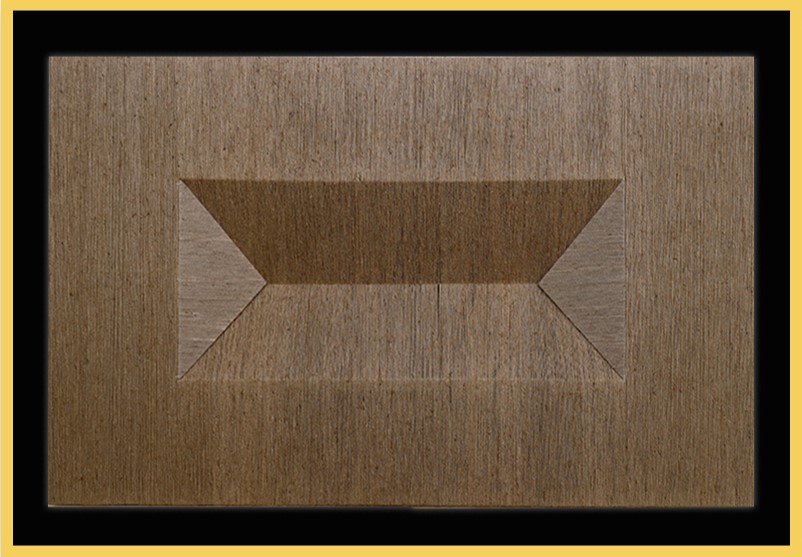
At the same time, Hadole’s surfaces carry an unmistakable emotional register that aligns him with a lineage of felt abstraction, artists who used reduction not to erase feeling, but to distil it. One senses an affinity with quiet grids, where repetition functions as a form of attention rather than control. Hadole treats geometry as a meditative framework, a way to steady the mind rather than dominate it. It is evident in the way he constructs the wood stretcher, and drapes the canvas over it deftly, almost like one was reenacting a childhood memory, shaping it to precision.
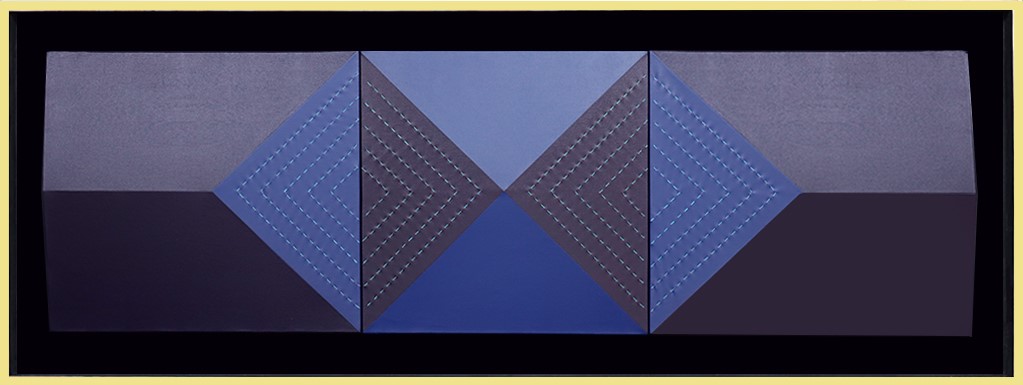
The stitched and layered qualities in his work also introduce a material memory absent from classical geometric abstraction. Here, the work quietly diverges from Western modernist purity and moves toward a more indigenous abstraction; one shaped by domestic knowledge, textile logic, and inherited labour. Hadole’s quilt-inspired works situate him within a broader global shift where abstraction absorbs cultural specificity without becoming illustrative of the milieu. The geometry does not reference craft directly, yet it carries its ethics: patience, repair, assembly, warmth.
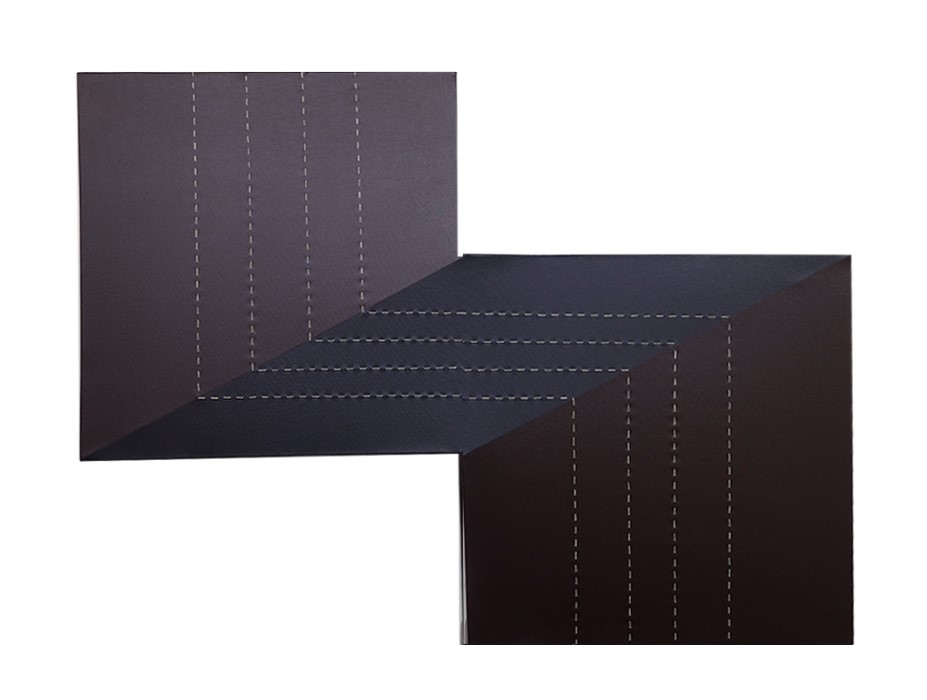
Emotionally, these works do not aim for expressionism. There is no outburst, no rupture. Instead, they emerge as a feeling that can exist in equilibrium, that care can be structured, that intimacy can be measured without being diminished. This places Hadole in dialogue with post-minimalist sensibilities, where restraint becomes a moral position rather than an aesthetic trick.
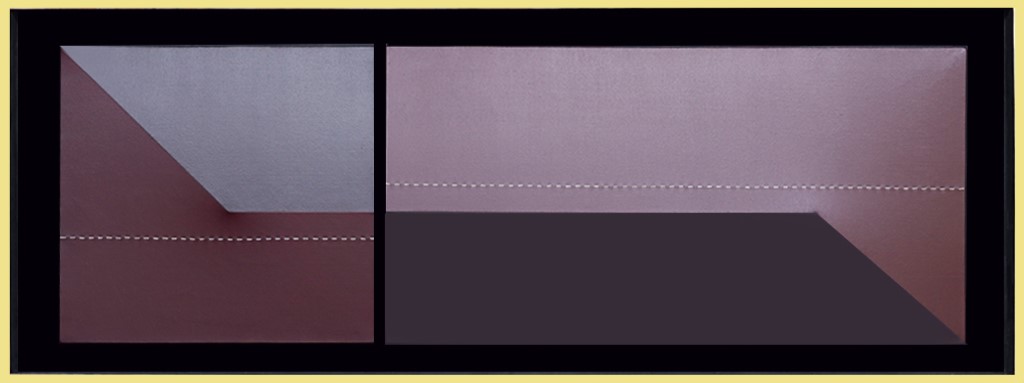
What makes Hadole’s paintings quietly radical is their ethics. They insist that stability is not the enemy of life. They argue, without preaching, that a composed surface can still carry intimacy, that precision can still be soft. Dhiraj Hadole’s geometry is not about control for its own sake; it is about building a space where inner turbulence can settle without being forgotten. In that sense, his work aligns with the exhibition’s spirit of Chitta–Chitra: the mind and heart translated into image, not through confession, but through construction.
These are paintings that behave like shelters. They do not shout to be understood. They stay, they steady, and they reward the viewer who is willing to slow down and meet them at their pace.Sushma Sabnis Mumbai December 2025
Be the first to comment on "Dhiraj Hadole’s latest show “Chittadarshani” at Jehangir Art Gallery"