

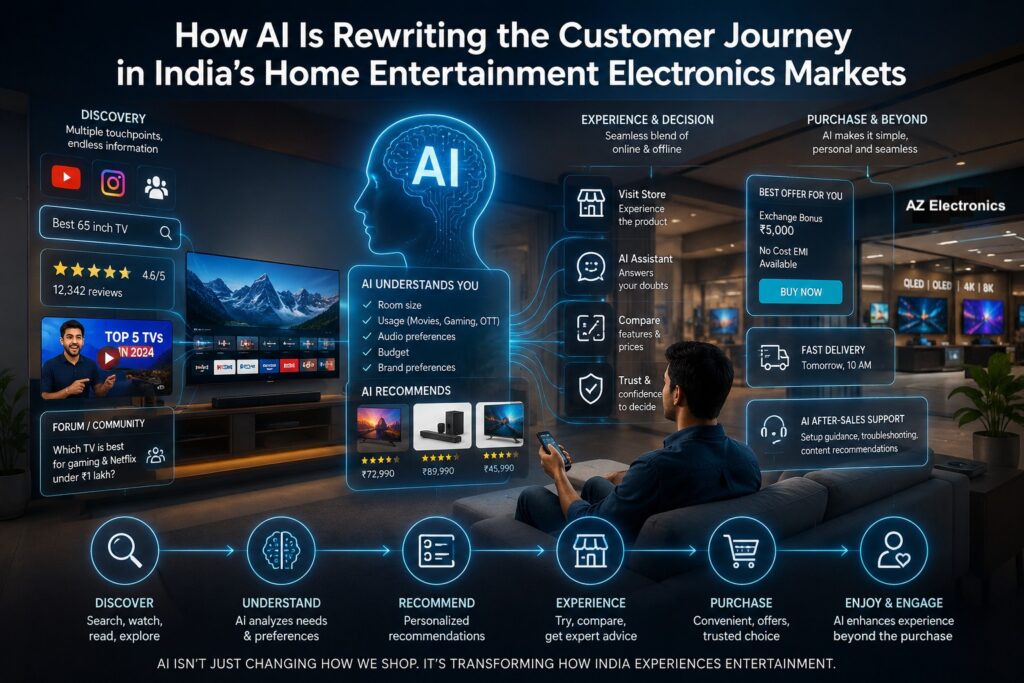
How AI Is Rewriting the Customer Journey in India’s Home Entertainment Electronics Markets
- By Ashish Saksena
Should I buy a 65-inch TV or a 75-inch TV?
Do I need a soundbar or a home theatre system?
Is Dolby Atmos worth paying extra for?
Which brands offer the best value?
Whom do I trust for the best advice?
A few years ago, consumers relied on friends, family, or the neighbourhood “tech expert” for answers. Currently, in view of the plethora of models, dozens of brands, thousands of online reviews, and conflicting opinions, consumers suffer from what behavioural scientists call information and choice overload. Artificial Intelligence (AI) now assists them in comparing products, summarising reviews, evaluating specifications, recommending options based on budgets and room sizes, and even suggesting the ideal entertainment setup based on viewing habits.
Evolving Trends-Consumer Markets and AI
India’s consumer electronics market has crossed USD 90 billion and continues to grow steadily. Despite the rapid growth of online commerce, nearly two-thirds of electronics sales still occur through offline channels. This trend is even stronger for non-IT consumer electronics such as Smart TVs, soundbars, home theatres, smart speakers, and audio systems, as consumers still want to experience picture quality, sound performance, and product aesthetics before making a purchase.
What has changed is the buying journey, which begins online through search engines, video reviews, marketplaces, social media platforms and online communities. This has created a hybrid model “Research Online, Buy Offline” (ROBO), the term introduced by Google as early as 2011. This model forms the base of a new type of retail, like Omni-Channel Retail or Phy-gital (Physical+Digital) format. We also have consumers following the reverse process. Another new Retail format has evolved to satisfy consumers’ needs of convenience and instant gratification- Quick Commerce- like Amazon’s 10-minute delivery, Blinkit, Instamart, etc., which delivers relatively high-involvement products like smartphones, laptops, smart watches, healthcare appliances, etc.
Turning to the motivations behind purchasing decisions, what drives choices today?
For home entertainment products, buying decisions are strongly driven by experience.
Consumers visit stores to:
• Compare display quality, sound quality and screen sizes.
• Experience features such as Dolby Atmos, HDR, Refresh rates,etc.
• Understand installation, warranty, and financing options.
Trust in the brand, salesperson expertise, after-sales service, and EMI availability continue to influence final conversion.
Online Influences
Online buying decisions are shaped by factors like
• Video reviews and demonstrations
• Customer ratings and reviews
• Influencer recommendations
• Price comparisons
• Discounts, Exchange offers and EMI schemes
Consumers increasingly use these to narrow their choices before entering a store or placing an order.
The Gen Z Difference
Traditional factors such as price, quality, warranty, and brand reputation remain important. However, Gen Z evaluates products differently.
They are influenced more by creators (YouTubers, influencers), communities, than advertisements, and experiences, than specifications, and factors like discounts, finance schemes, exchange offers, etc. Their perception of a television is not merely a display device but a gateway to gaming, streaming, content creation, and social entertainment.
The AI Revolution in Consumer Decision-Making
AI is emerging as the most disruptive force in the category. Consumers can simply share their direct need-based questions and evolve into giving accurate prompts and AI, as a digital advisor helps them to evaluate all the options and alternatives, enabling better-informed need-based decisions.
The influence of AI extends beyond online shopping.
Offline Retailers are increasingly deploying AI-powered recommendation engines, virtual shopping assistants, smart kiosks, and personalized promotions inside stores.
Manufacturers are embedding AI directly into products through features such as AI upscaling, adaptive sound tuning, voice interfaces, predictive optimization, and personalized viewing experiences, Thus, AI now impacts both how consumers choose products and how those products continue to add value after purchase.
Enhanced Customer Benefits
AI helps in creating tangible benefits:
• From confusion to confidence: “I can make a smarter decision with less effort.”
• From generic selling to personalization: “The recommendation feels designed specifically for me.”
• From purchase anxiety to reassurance: “I feel quite confident of making the right choice.”
• From endless research to efficiency: “I get the best combination of performance, service, and price while saving time.”
• From product ownership to experiences: “My living room has become a personalized entertainment hub.”
• From disconnected devices to seamless ecosystems: “All devices work together seamlessly.”
Beyond functional benefits, customers also end up feeling more satisfied:
• I have done enough research.
• I made the right choice.
• My setup reflects my lifestyle.
• I am enjoying a premium experience.
Looking Ahead
Over the next five years, AI is likely to accelerate several trends:
• Virtual and augmented reality product demonstrations
• – virtual trials of spectacles, ornaments, dresses
• – How a TV or sound system will look in your entertainment room
• Predictive upgrades and maintenance alerts- Your current sound system is now unable to provide sufficient sound and needs an upgrade.
• AI-driven Product Enhancements – Speakers reconfigure to minimize reflections and optimize sound quality on a real-time basis
• AI-powered Quick Commerce- Regular purchase items of a consumer from quick commerce on weekends appear in the app on Fridays, with pop-up messages, if enabled.
• Role of AI in Offline stores to expand to a ‘Third Umpire’ role, for observing and storing intra-store traffic with time stamps, time spent in each department, etc., and providing analytics like sales ratios vis-à-vis number of demos, time spent, etc.
• Generative AI will be visually identifying repeat, regular and new consumers, linking them to online searches done before, and sharing the insights with the attending salesperson for customized offerings!
The future of home entertainment electronics will be defined by how effectively brands, retailers, and AI synergize to help consumers answer a simple question:
“What is the right entertainment solution for me?”
AI is, in a way, helping retailers to create the traditional Indian hospitality-driven culture, treating each customer as a valued guest, serving each as per unique needs and preferences, with Retailers living up to their core values, which reflect in their brand promise /taglines like ‘Where Trust meets Technology’, ‘We help you buy’, etc.
Ashish Saksena is a Retail and Consumer Marketing Professional into consultancy and with over 30 years of experience in consumer durables, electronics retailing, and customer experience management. He has worked with many companies like Philips, Sony, Haier, HCL. His areas of interest include Consumer Behaviour, Omnichannel Retailing, AI-driven customer journeys, and Emerging Retail technologies. Email-ashish@value-products.in
ends GNI
Be the first to comment on "How AI Is Rewriting the Customer Journey in India’s Home Entertainment Electronics Markets"