
“Visthapan”
A Solo Show of Recent Work by Vishwa Sahni
Jehangir Art Gallery
Kala Ghoda, Mumbai 400001
Timing: 11am to 7pm
From: 14th to 20th October 2025
Contact: +91 9324647023
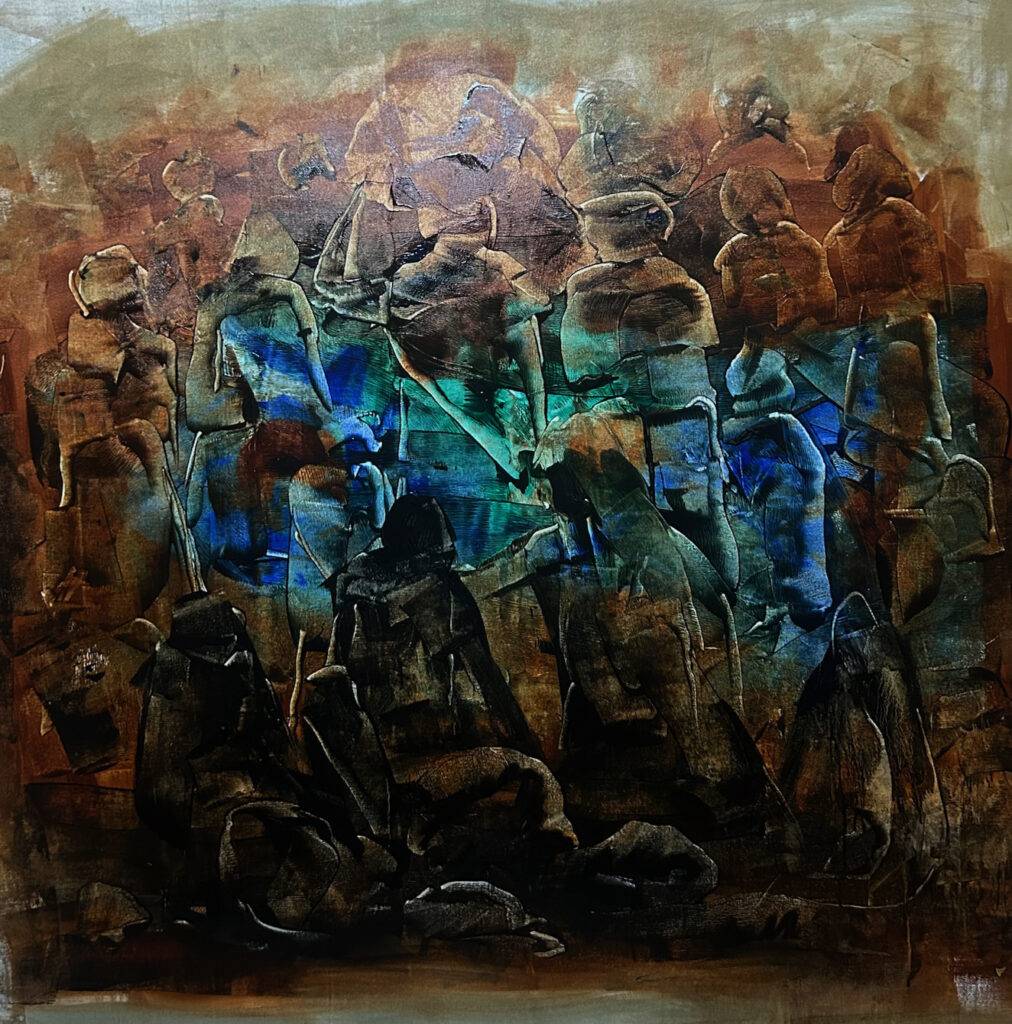
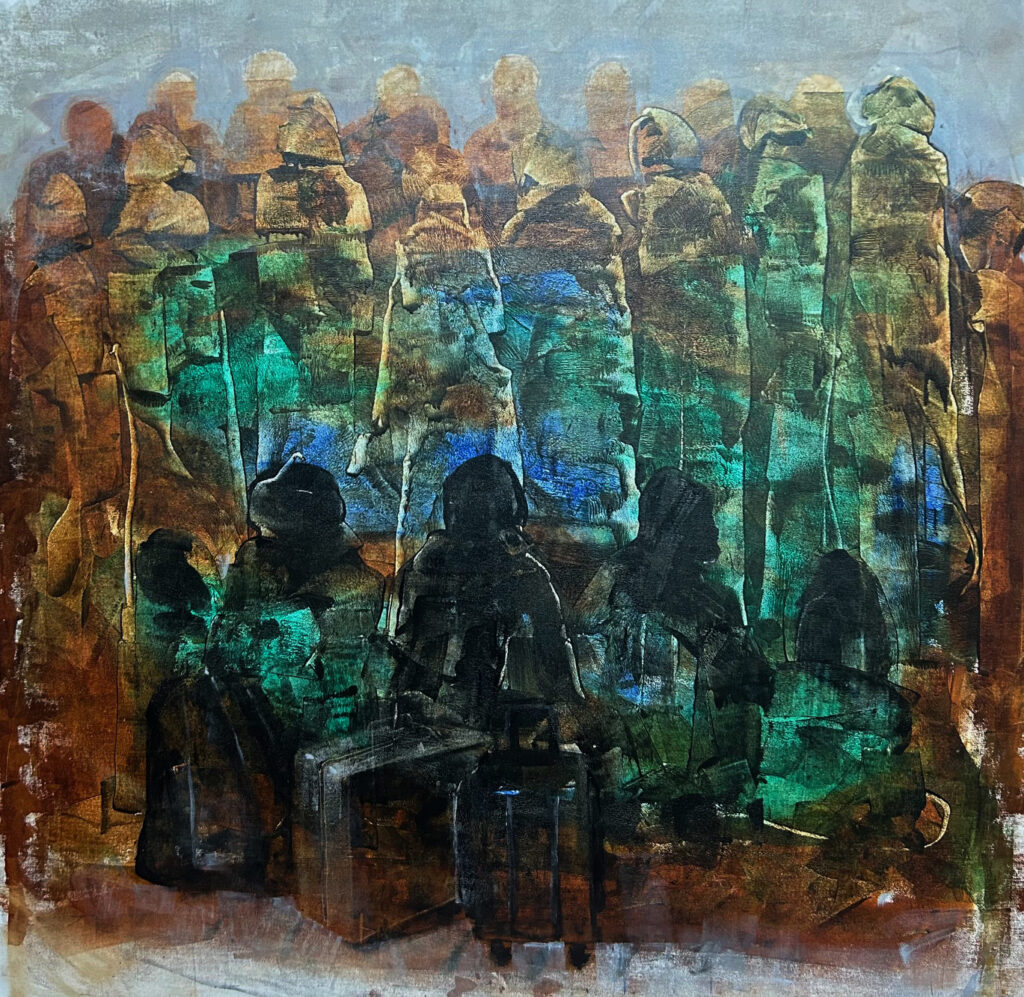
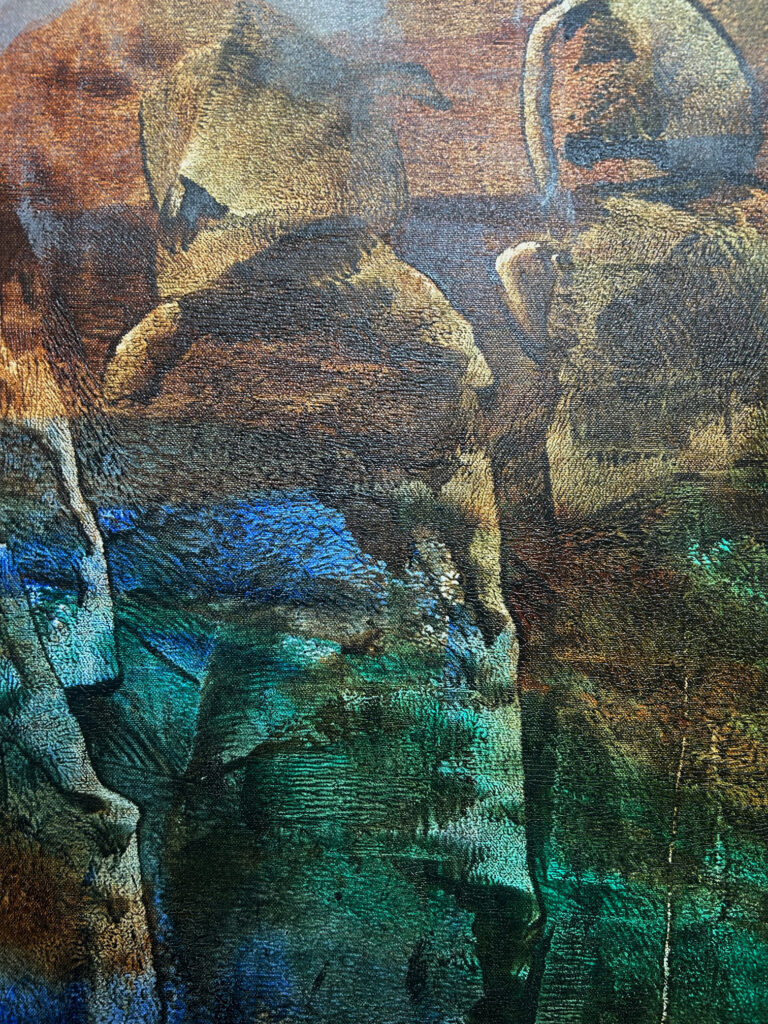
Vishwa Sahni’s painting seems to have been focused for some time on the contention that abstraction, if allowed to breathe in a deeper pictorial space, can maintain visual opulence without drifting too far from its essentially two-dimensional syntax. Among a generation of artists who matured on this side of painting’s pluralist expansion, where each painter’s style, look and touch was far more varied than that of their predecessors, Sahni held to a firm figurative scaffold based on migration both perceived and imagined. Though the iconography in this recent work remains readable each painting’s horizon is still easy to find, there is in newer panels a softening of the edges and a swelling of forms that now shimmer behind translucent washes instead of bending, as they once did, into each other’s space. From an optimal distance coerced from the viewer by the five feet by nine feet spread of their frames their reconfigured cohesion seems to rely less on drawing and more on a spontaneous manipulation of hue and texture.
The resulting airiness is a clear departure from his earlier work, which is reprised in this exhibition, an example of his harder-edged shapes, apparently reconstituted during the painting’s many stages of development so as not to diminish the careful coordinating of its unique structural invention. To drift from the success of this method is risky, for what’s been so appealing about Sahni’s work until now has been precisely its interconnected complexity. The changes seen in this exhibition may be attributed in some measure to his establishing a studio in Mumbai, a move from country life in Madanpur, for reasons linked to the landscape itself, resetting a painter’s perspective.
A clue to the path taken in this shift between the earlier compositions and these newer, cloudier apparitions may be found in seven-foot square painting representing the artist’s trials at keeping the structure fixed tighter to the surface. Here, a familiarity with Sahni’s elevated horizon line helps the viewer read the ghost of a landscape that still exists despite the missing diagonals and story-book trees of his earlier work, elements that had once supported the artist’s penchant for excavating spatial illusion with little cost to a lively surface. Visthapanmarks the change as its simplified shapes are not immediately recognizable as landscape elements. They also seem unusually tolerant of each other’s position in the composition.
A clue to the path taken in this shift between the earlier compositions and these newer, cloudier apparitions may be found in seven-foot square painting representing the artist’s trials at keeping the structure fixed tighter to the surface. Here, a familiarity with Sahni’s elevated horizon line helps the viewer read the ghost of a landscape that still exists despite the missing diagonals and story-book trees of his earlier work, elements that had once supported the artist’s penchant for excavating spatial illusion with little cost to a lively surface. Visthapanmarks the change as its simplified shapes are not immediately recognizable as landscape elements. They also seem unusually tolerant of each other’s position in the composition.
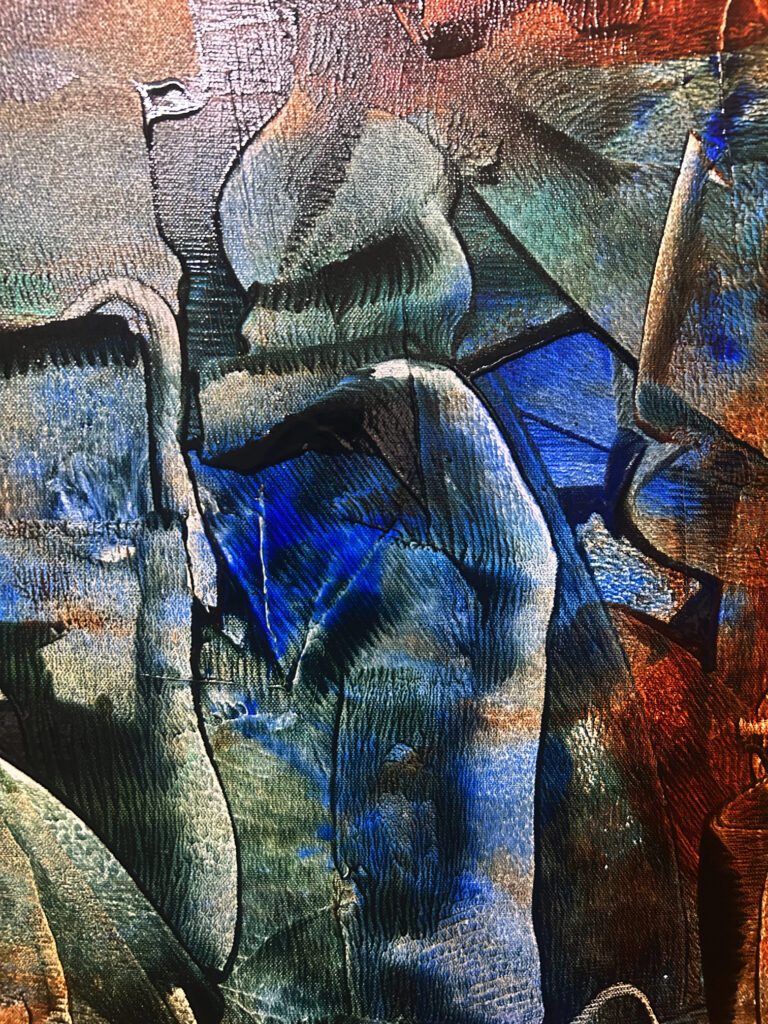
And yet to my eye the most adventurous of the newer canvases in the show, still owes something to the lexicon of the earlier work, though here it seems Sahni’s method has turned to a new and pronounced improvisation. Visthapan’s surface remains in a perturbed state. Edges are ragged and makeshift. Translucency dominates. There is even a gestural coarseness replacing what was once a controlled chaos of endlessly suggestive shapes. The color alone in Visthapan provides the link to earlier work, being mostly middle tones of contingent primary and secondary hues.
For anyone who has followed Sahni’s work these many years, an effort to catch up to where he is now will require diligence, which I believe is a fair expectation for him to make as his paintings have always appealed to a visually smart audience. Because his abundant inventiveness had constituted as near a legible pictorial language as created by any painter in recent memory, encountering its contraction will demand a real and unavoidable learning curve. Sahni is a painter whose strength had always been his ability to develop variations on a theme. The construction of an intelligent, readable and teasingly ambiguous pictorial image, still speaks to a continuity of vision.
Sahni has never been a painter fixated on concocting a new look, and there is no indication here of chasing novelty, nor is there any hint of applying arbitrary effects to avoid comparison with contemporaries. From the beginning his work has been a conscious adaptation of migrant landscape elements knit tightly into compositions that owed a great deal of their cohesion to those compositional properties that as any instructor knows are maddeningly difficult to formulate verbally but can be appreciated in its many variations. As galleries continue to hawk brightly colored things apparently meant for the simpler aim of accessorizing the expansive blank walls that once provided inexpensive working space for artists, it gives one hope to watch a painter keep to self-imposed limitations, not in spite of, but because there is more than enough room within a rectangle of canvas to address a thoughtful and historically aware sensibility.
Abhijeet Gondkar/14th October 2025, Mumbai
Be the first to comment on "“Visthapan” A Solo Show of Recent Work will be displayed by Vishwa Sahni in Jehangir Art Gallery in Mumbai"