
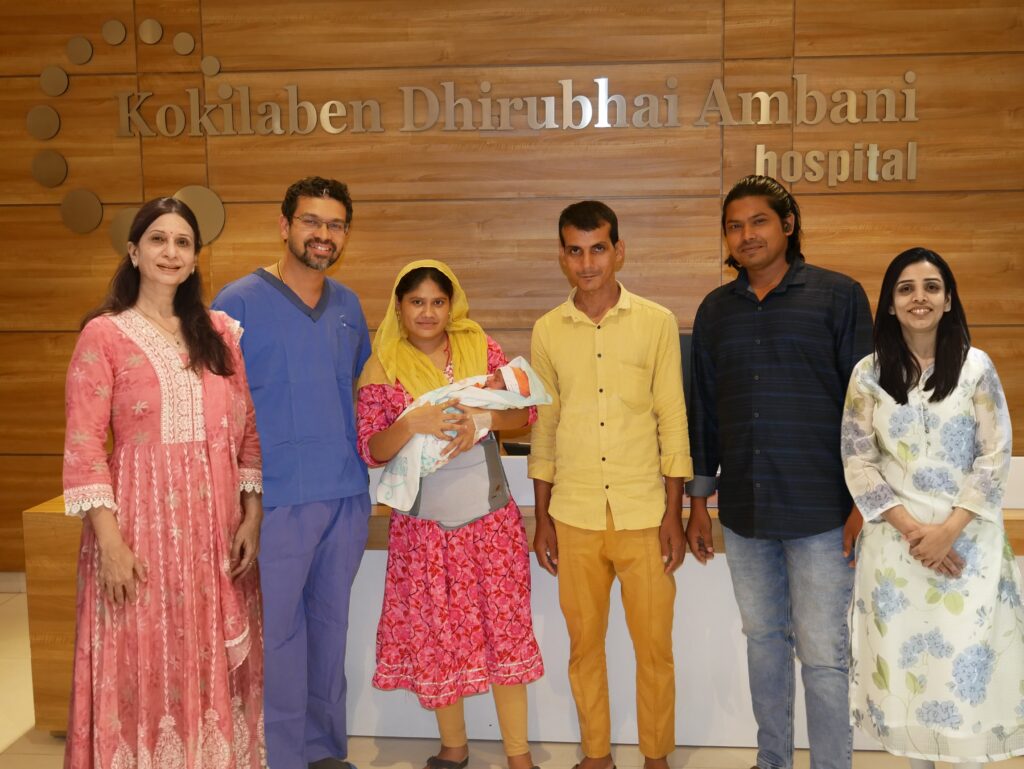
Against All Odds: 28 year old woman with Rare Hemophilia Type 3 Safely Delivers Baby at Kokilaben Hospital, Navi Mumbai
A one-in-a-million rare condition with pregnancy saved by clinical expertise, teamwork, and timely intervention
Navi Mumbai, 19 June 2025: For 28-year-old Najni Khan, a resident of a modest town in Gujarat, motherhood had once seemed like an impossible dream. After two pregnancy losses, she and her husband – a daily wage worker – had little hope when she conceived again. The joy was quickly overshadowed by a life-threatening reality: she was diagnosed with Type 3 Hemophilia, one of the rarest bleeding disorders in the world, affecting less than 1 in 1,000,000 women.
Unlike the more common hemophilia that primarily affects men, Type 3 Von Willebrand Disease the most severe form can be devastating for women, particularly during pregnancy and childbirth. With extremely low levels of clotting factor (Factor VIII and Von Willebrand Factor), even the smallest injury or internal shift in the body can lead to uncontrollable bleeding.
At seven months pregnant, Najni experienced persistent bleeding that threatened not only her pregnancy but her life. Her condition required a multidisciplinary, resource-intensive approach something often unavailable in lower-income settings.
But hope emerged in the form of a committed medical team that refused to give up.
Dr. Kunal Goyal, Consultant, Haemato-oncologist, BMT and Cellular Therapies (CAR-T), Kokilaben Hospital, Navi Mumbai, took charge of the case. “She had severe deficiency of clotting factors, and spontaneous bleeding was a constant risk. In this case, even a routine delivery could have turned fatal,” the doctor recalled. “When she came to us, she had a history of two previous pregnancy losses, possibly related to undiagnosed bleeding episodes. The challenge was not just stopping her immediate bleeding, but ensuring her pregnancy could safely reach full term,”he added. “Every week of pregnancy carried risk. We monitored her closely, coordinated with the gynecology and critical care teams, and ensured factor support throughout. At nine months, we planned the delivery meticulously, with backup vials, ICU readiness, and full team coordination. It was a high-stakes case, but with structured planning, we achieved the best outcome possible both mother and baby are doing well.”
“We were fully prepared and had anticipated every possible complication,” said Dr. Renuka Borisa, Consultant, Obstetrics & Gynaecology, who led the delivery. “Three days before the C-section, we stabilized her condition and administered clotting factor injections to build her levels. We initially planned for a normal delivery, but her labor didn’t progress, so we made the calculated decision to move to a C-section. The key was meticulous coordination ensuring clotting factor availability, controlling fluctuating vitals, and minimizing blood loss.
A comprehensive treatment plan was developed, involving obstetricians, hematologists, anesthetists, ENT specialists, and pediatricians. The team coordinated nasal packing to stop internal bleeds and sourced specialized Factor VIII and Von Willebrand Factor concentrates highly purified.
Financial constraints added another layer of complexity, as the family could not afford specialized treatment or the costly factor concentrates. The hospital provided guidance and assistance in sourcing financial support, and through internal resources, the team was able to ensure she received the therapy without burdening the family.
Her cesarean section was performed with utmost precision. Doctors closely monitored factor levels throughout surgery, maintaining them between 70–100% of normal, minimizing blood loss. Post-operatively, both mother and baby were observed in the ICU and NICU respectively, with care extending over several days.
The result? A healthy delivery and a new lease on life for a family that had all but given up hope. This was more than a clinical success. It was a human story of resilience, empathy, and medical courage.
Today, Najni is back home with her newborn, both doing well. Her story is now being cited as a benchmark case for managing high-risk pregnancies in hemophilia Type 3 patients, where national protocols are scarce and expertise rare.
“After losing two pregnancies, we had almost given up hope. But the doctors at Kokilaben Hospital supported us every step of the way. Thanks to their care, I could safely deliver my baby. We are forever grateful.” saidNajni Khan, the patient, reflecting on her journey.
Dr. Shashikant Pawar, COO Kokilaben Hospital, Navi Mumbai added – “We at Kokilaben Hospital Navi Mumbai, pioneer in treating rare and challenging cases to deliver excellent outcomes. In this cases our team of doctors have demonstrated this and was able save the life, for us every life matters. In a country where maternal mortality remains a challenge even in low-risk pregnancies, this case sets a precedent for how early diagnosis, teamwork, and inclusive healthcare access can turn around the most critical cases.”ends GNI
Be the first to comment on "Against All Odds: 28 year old woman with Rare Hemophilia Type 3 Safely Delivers Baby at Kokilaben Hospital, Navi Mumbai"