
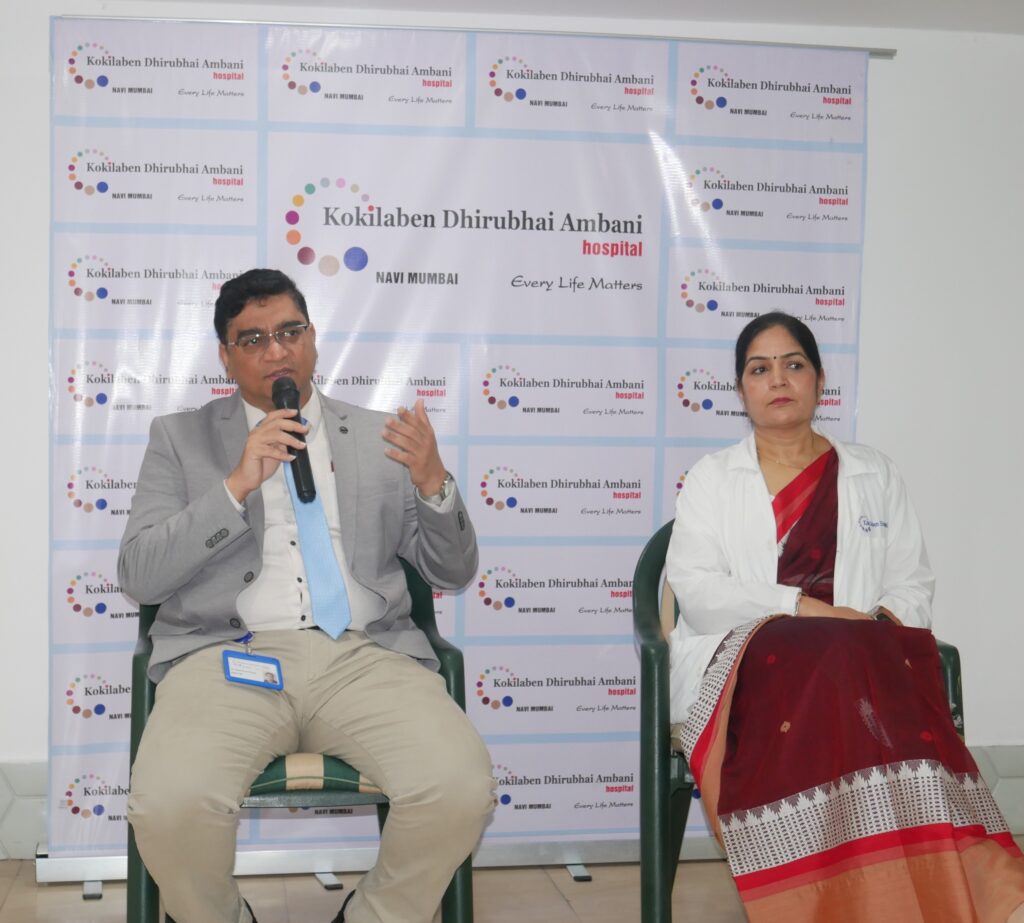
Photo Caption – Dr. Shashikant Pawar, Chief Operating Officer & Dr. Poonam Gupta, Director, Laboratory Medicine; Consultant, Microbiology and Infection Prevention from Kokilaben Dhirubhai Ambani Hospital Navi Mumbai
Kokilaben Dhirubhai Ambani Hospital, Navi Mumbai Marks Eight Years with Release of Navi Mumbai Annual Health Report
Navi Mumbai, July 24, 2026 (GNI) : Kokilaben Dhirubhai Ambani Hospital, Navi Mumbai released the Navi Mumbai Annual Health Report, a comprehensive year-long health study conducted by its Department of Laboratory Medicine. The report’s release coincides with the hospital commemorating eight years of dedicated service, ethical clinical practices, and patient-centric healthcare in Navi Mumbai and surrounding regions.
Since its foundation in 2018, the hospital has stood firm in its promise to provide top-notch healthcare through innovation driven by the best technology and expertise, complemented by great service. Over the past eight years, the hospital has strengthened and expanded its Centres of Excellence across cardiology, oncology, neurosciences, orthopaedics, renal sciences and transplants, successfully treating complex and high-risk cases for patients from across Navi Mumbai and neighbouring regions.
Designed as a data-driven initiative to give insights on the state of health in the region, the report enables doctors, residents, and the corporate workforce to proactively track and manage health. Built on anonymized insights from 100,986 laboratory investigations across 32,253 anonymized Executive Health Checks between April 2025 and March 2026. The cohort comprised 13,901 female and 18,352 male participants, with an average age of 44.8 years, a primarily working-age professional population.
Dr. Shashikant Pawar, Chief Operating Officer, Kokilaben Dhirubhai Ambani Hospital, Navi Mumbai, added, “Our eight-year journey has been one of steady and responsible growth in service of the people of Navi Mumbai and the surrounding regions. We have focused on building a strong foundation driven by experienced full-time specialists, ethical and evidence-based clinical practices, and advanced, patient-centric care. We have also been committed to bringing advanced medical technologies to Navi Mumbai, ensuring that patients have access to world-class diagnostics and treatment closer to home. Alongside curative care, we place significant emphasis on primordial intervention and preventive healthcare, encouraging early risk identification, timely diagnosis, and appropriate treatment to deliver better long-term health outcomes for individuals and the community. The Navi Mumbai Annual Health Report reflects this commitment and will now be an annual feature as we remain dedicated to expanding access to quality healthcare while upholding the highest standards of clinical excellence and patient care.”
The findings, presented by Dr. Poonam Gupta, Director, Laboratory Medicine; Consultant, Microbiology and Infection Prevention, Kokilaben Dhirubhai Ambani Hospital, Navi Mumbai, reveal a cluster of largely silent cardiometabolic and nutritional risks that are highly prevalent, but which go frequently undiagnosed.
Vitamin D and Vitamin B12 Deficiency
Vitamin D emerged as the single most widespread deficiency, with more than 75% of screened individuals falling below the normal threshold.
Vitamin B12 deficiency affected 24% to 25% of those tested, with a rising trend through the year, peaking at 27.3% in February 2026, likely linked to certain dietary preferences
Pre-diabetes and Diabetes
Risk of developing diabetes was strikingly high. With regard to HbA1c, a test that shows average blood sugar over the past 2-3 months with normal levels below 5.7%, 54% of screened individuals were at risk of developing abnormal sugar levels (dysglycemia) and progressing to prediabetes and diabetes.
Anaemia
Nearly one in two women screened operates with low red blood cell mass.
Male anaemia was far lower in the broad screening population
Dyslipidaemia (Cholesterol and LDL)
Elevated LDL cholesterol affected 32% of the screened population.
High total cholesterol was found in 30%.
Cardiometabolic Clustering
The data revealed that metabolic and cardiovascular risks occur together. Individuals with any lipid abnormality were 2.21 times more likely to also show elevated blood sugar.
Together, these six silent risk factors, Vitamin D deficiency, dysglycaemia, female anaemia, elevated LDL, high cholesterol and Vitamin B12 deficiency, underscore the value of routine, structured screening in an apparently healthy working-age population, where early detection offers the clearest window for prevention.ends GNI
Be the first to comment on "Kokilaben Dhirubhai Ambani Hospital, Navi Mumbai Marks Eight Years with Release of Navi Mumbai Annual Health Report"